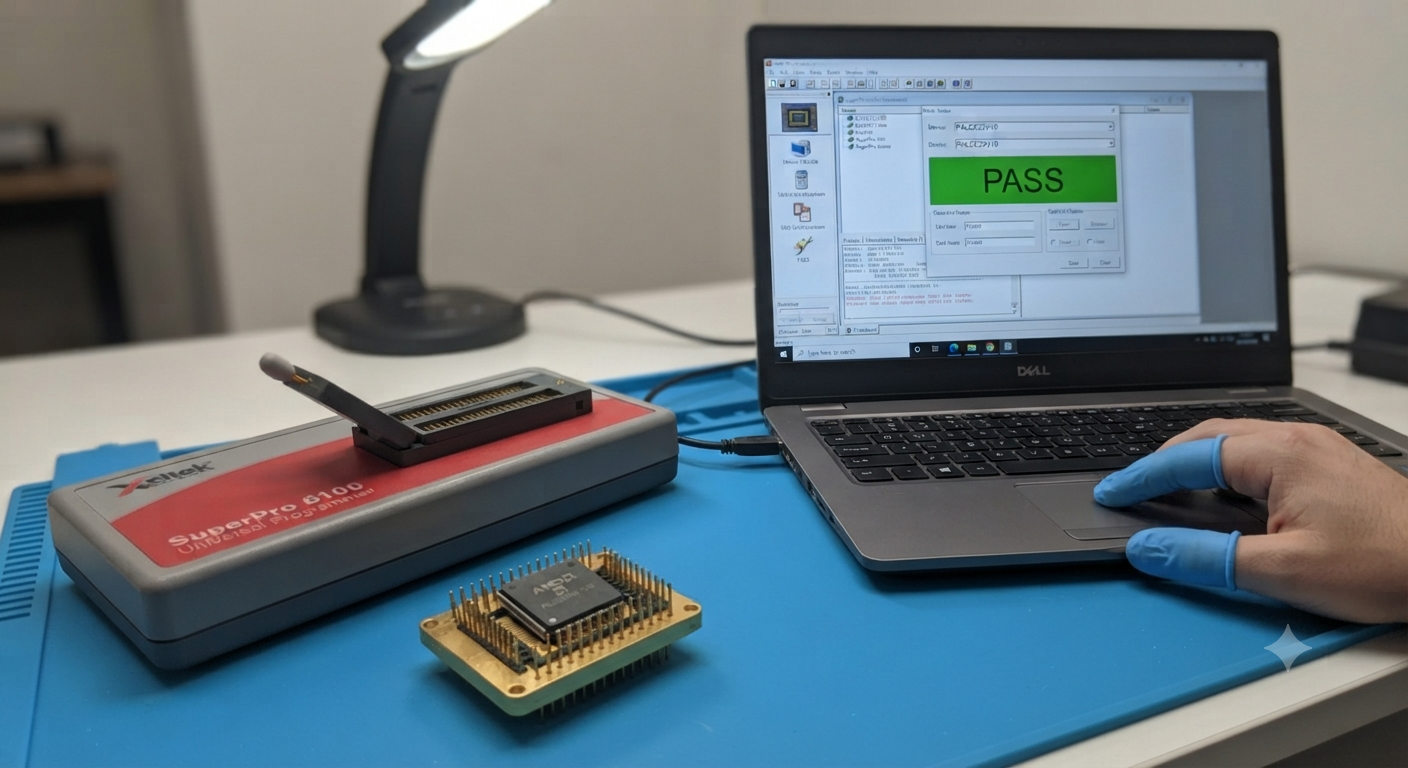
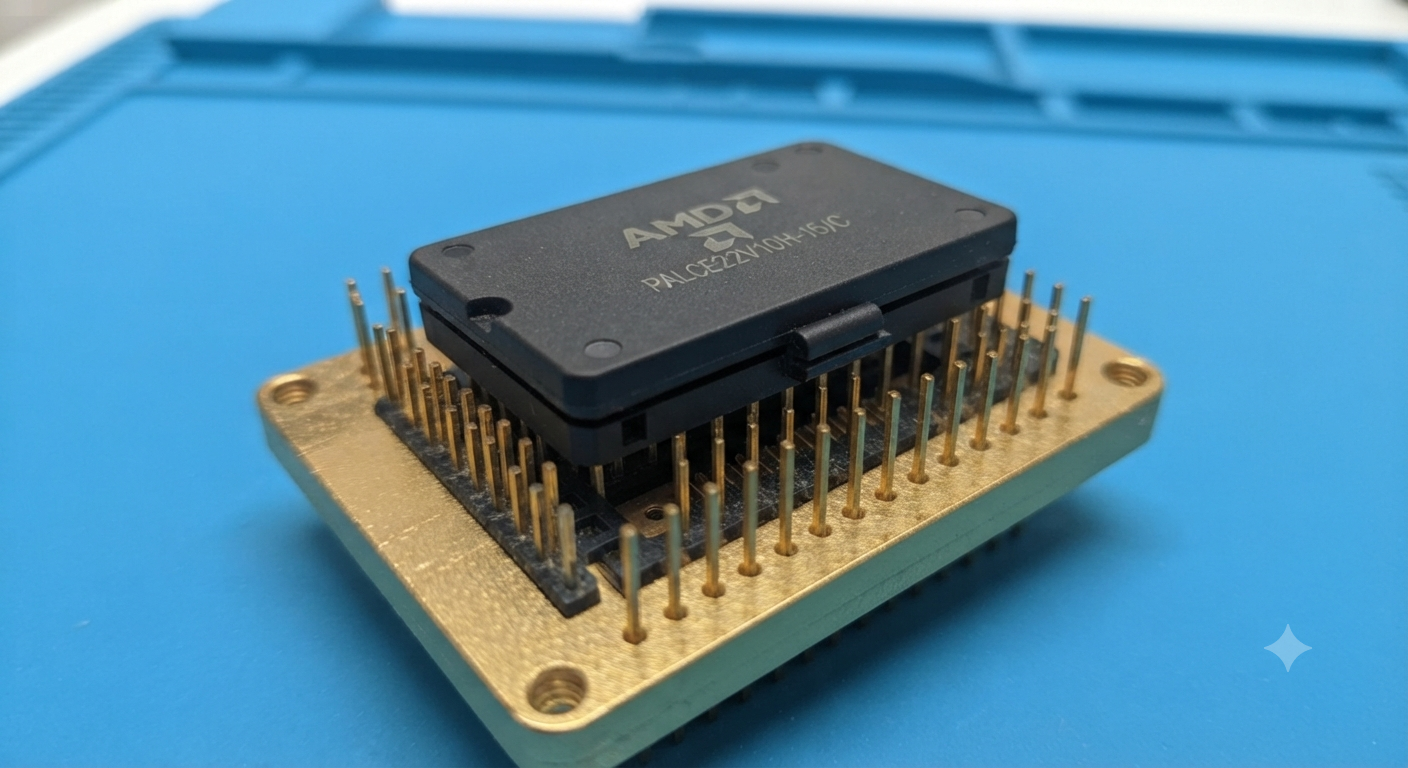
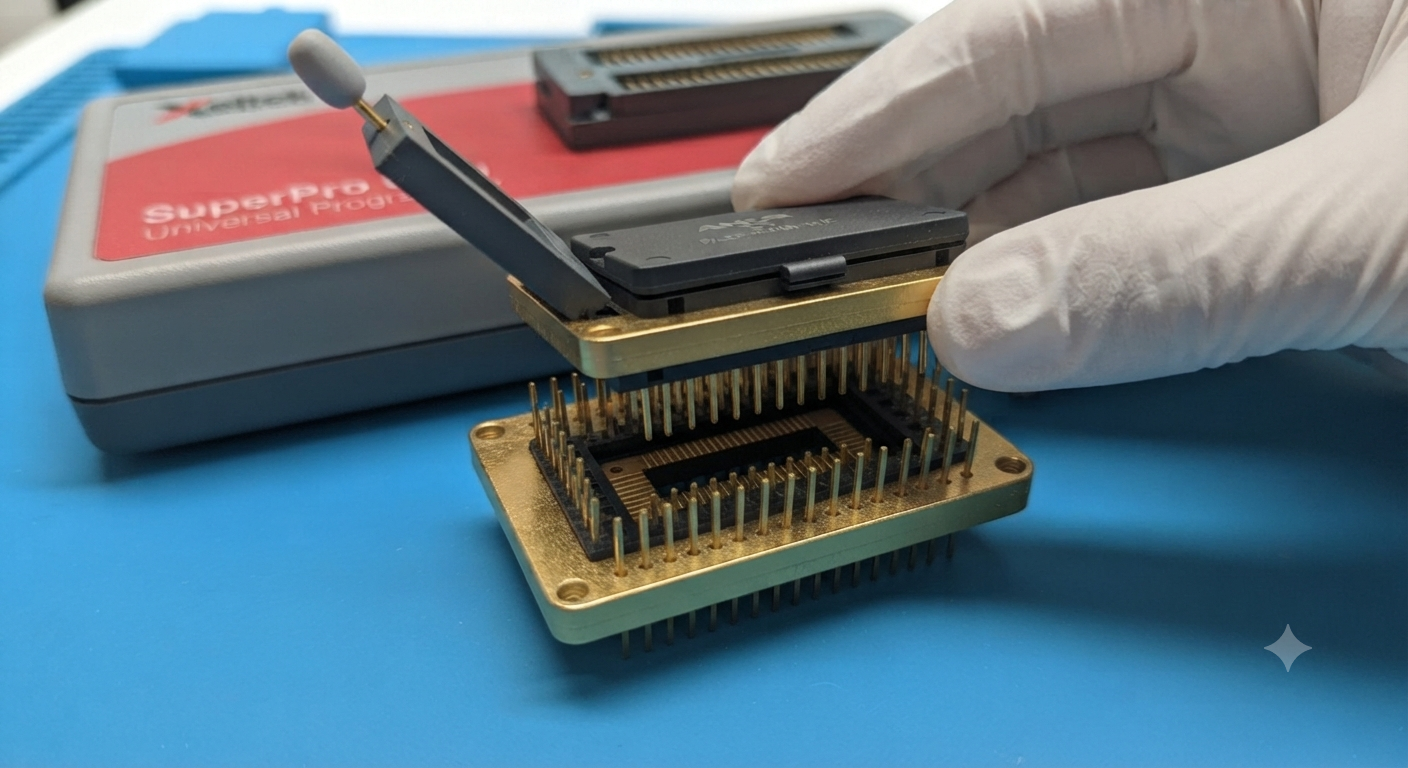
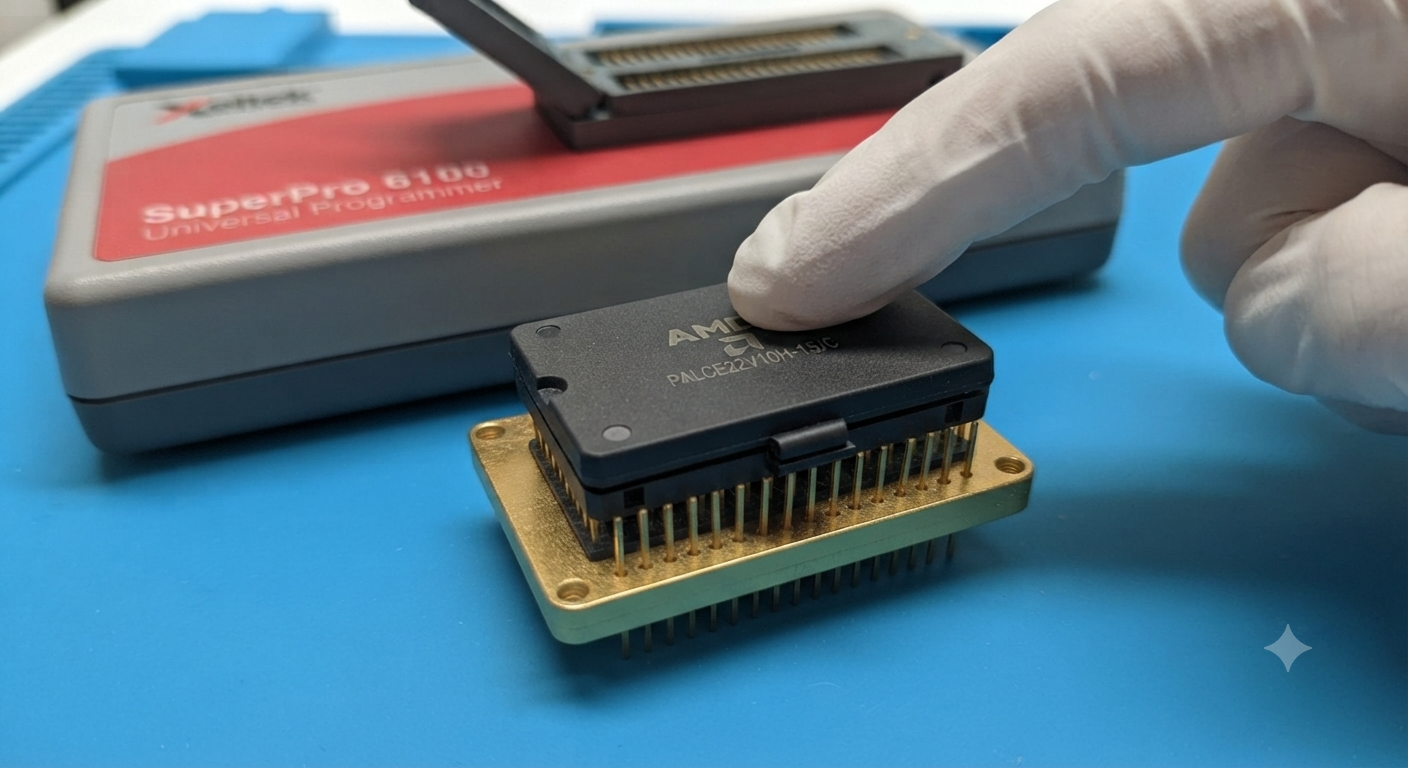
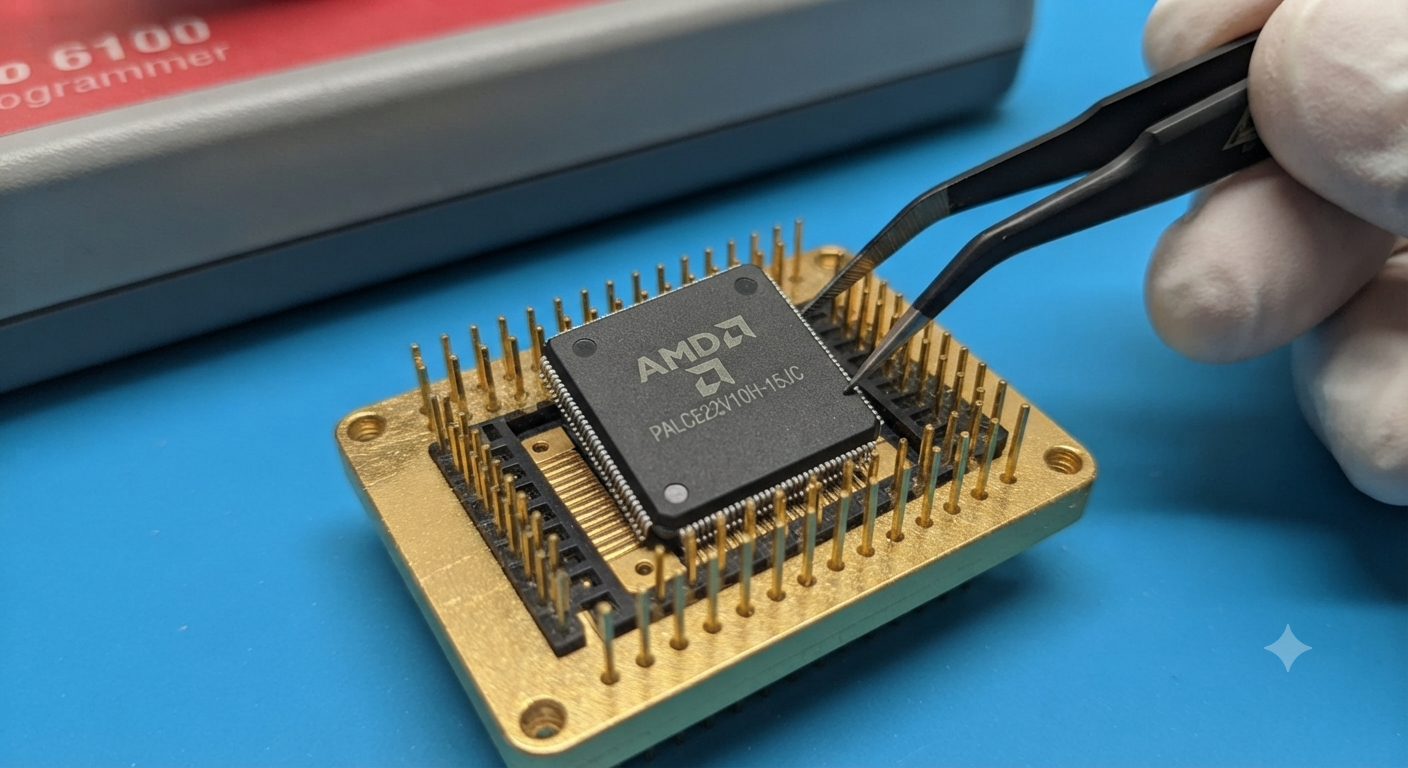
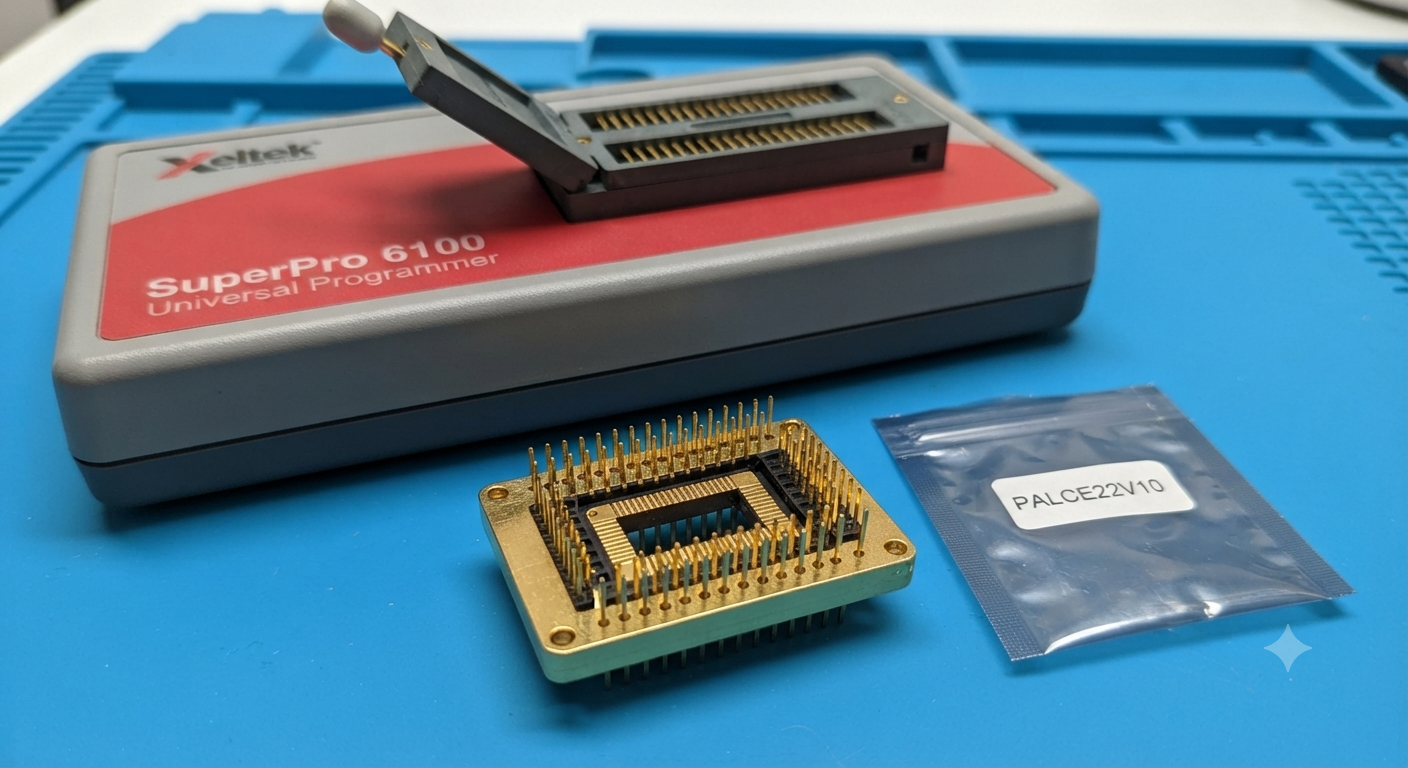
The PALCE22V10 is a versatile 24-pin EE-CMOS programmable logic device engineered to replace conventional discrete SSI and MSI logic gates with a flexible, high-speed architecture. Featuring 10 independently configurable macrocells and variable product term distribution ranging from 8 to 16 product terms per output, this hardware logic device excels at implementing complex state machines, address decoders, and custom control functions.
Per analizzare, sbloccare o eseguire il readout della matrice di configurazione nascosta all’interno di un Lattice CPLD PALCE22V10 protetto, gli ingegneri della microelettronica utilizzano metodi di analisi fisica non distruttiva sul contenitore in silicio esposto. Attraverso un’attenta gestione dei meccanismi di sicurezza interni del Lattice CPLD PALCE22V10 mediante variazioni controllate della tensione, tecniche di probing laser di precisione o sollecitazioni termiche mirate, i tecnici possono temporaneamente superare i meccanismi di protezione senza danneggiare le macrocelle fondamentali. Una volta ripristinate le linee di comunicazione, gli ingegneri possono acquisire la matrice grezza dei fusibili del Lattice CPLD PALCE22V10 contenuta nei blocchi interni di EEPROM, Flash o memoria statica. Il personale tecnico può quindi copiare gli esatti percorsi logici, estrarre le regole proprietarie di configurazione firmware o di instradamento del codice sorgente del Lattice CPLD PALCE22V10 e convertire il risultato in un file binario o esadecimale verificato, ottenendo una riproduzione completa del software originale e dei contenuti dati del programma.
Originally produced across major semiconductor silicon lines including lattice, Cypress, and AMD, these reliable components remain heavily deployed in telecommunications infrastructure, industrial automation racks, medical diagnostic systems, and aerospace avionics. To shield proprietary logic arrays and boolean sum-of-products implementations against unauthorized inspection or competitor cloning, hardware designers routinely activate the integrated security fuse during volume programming. Once set, this security bit forces the array to read back as if completely erased, effectively creating a locked perimeter that blocks standard universal programmers from accessing the internal routing matrix.
When technical teams need to execute a specialized read pld ic palce22v10 project on a secured target, standard software debugging utility tools are insufficient. Successfully performing a security bypass on a locked or encrypted logic gate array demands precise physical semiconductor engineering. To crack, unlock, decrypt, or readout the hidden configuration matrix inside a protected chip or ic, microelectronics engineers utilize non-destructive physical analysis methods on the exposed silicon package.
Para analizar, desbloquear o realizar un readout de la matriz de configuración oculta dentro de un Lattice CPLD PALCE22V10 protegido, los ingenieros de microelectrónica utilizan métodos de análisis físico no destructivo sobre el encapsulado de silicio expuesto. Mediante la superación controlada de los mecanismos internos de seguridad del Lattice CPLD PALCE22V10 utilizando manipulación precisa de voltaje, técnicas de sondeo láser de alta precisión o estrés térmico dirigido, los técnicos pueden omitir temporalmente los sistemas de protección sin dañar las macroceldas principales. Una vez restauradas las líneas de comunicación, los ingenieros pueden extraer la matriz de fusibles sin procesar del Lattice CPLD PALCE22V10 almacenada dentro de bloques internos de EEPROM, memoria Flash o memoria estática. Posteriormente, el personal técnico puede copiar las rutas lógicas exactas, extraer las reglas propietarias de firmware o de direccionamiento del código fuente del Lattice CPLD PALCE22V10 y convertir la información obtenida en un archivo binario o hexadecimal verificado, generando una reproducción completa del software original y del contenido de datos del programa.
By carefully overcoming the internal security fuse through controlled voltage manipulation, precision laser probing, or targeted thermal stress, technicians temporarily bypass the protective security latch without damaging the core macrocells. Once communication lines are restored, engineers can dump the raw fuse matrix embedded within internal eeprom, flash, or static memory blocks. Technical staff can then copy the exact logic paths, extract the proprietary firmware or source code routing rules, and convert the output into a verified binary or heximal file, yielding a complete software reproduction of the original program and data contents.
The PALCE22V10 provides user-programmable logic for replacing conventional SSI/MSI gates and flip-flops at a reduced chip count. The PALCE22V10Z is an advanced PAL® device built with zero-power, high-speed, electrically-erasable CMOS technology. It provides user-programmable logic for replacing conventional zero-power CMOS SSI/MSI gates and flip-flops at a reduced chip count. The PAL device implements the familiar Boolean logic transfer function, the sum of products. The PAL device is a programmable AND array driving a fixed OR array. The AND array is programmed to create custom product terms, while the OR array sums selected terms at the outputs.
Для анализа, разблокировки или выполнения считывания скрытой конфигурационной матрицы внутри защищённого Lattice CPLD PALCE22V10 инженеры микроэлектроники применяют неразрушающие методы физического исследования открытого кремниевого корпуса. Путём контролируемого обхода внутренних механизмов защиты Lattice CPLD PALCE22V10 с использованием точного управления напряжением, лазерного зондирования высокой точности или направленного термического воздействия специалисты временно преодолевают защитные механизмы без повреждения основных макроячеек. После восстановления линий связи инженеры могут получить исходную матрицу предохранителей Lattice CPLD PALCE22V10, содержащуюся во внутренних блоках EEPROM, Flash-памяти или статической памяти. Затем технический персонал может скопировать точные логические маршруты, извлечь фирменные правила конфигурации прошивки или маршрутизации исходного кода Lattice CPLD PALCE22V10 и преобразовать полученные данные в проверенный бинарный или HEX-файл, обеспечивая полное воспроизведение исходного программного обеспечения и содержимого данных оригинальной программы.
The growing global market demand to replicate, copy, dump, or readout protected logic patterns from a locked cpld or programmable logic array is driven by severe component supply disruptions and legacy hardware maintenance challenges. Millions of critical production lines, automated power sub-stations, and heavy industrial machines continue to rely on aging circuit assemblies containing obsolete or outdate logic components whose original software design archives have been lost due to vendor dissolution or corrupted storage media.
Para analisar, desbloquear ou realizar o readout da matriz de configuração oculta dentro de um Lattice CPLD PALCE22V10 protegido, engenheiros de microeletrônica utilizam métodos de análise física não destrutiva sobre o encapsulamento de silício exposto. Através da superação controlada dos mecanismos internos de segurança do Lattice CPLD PALCE22V10 utilizando manipulação precisa de tensão, sondagem a laser de alta precisão ou estresse térmico direcionado, os técnicos podem contornar temporariamente os sistemas de proteção sem danificar as macrocélulas principais. Após a restauração das linhas de comunicação, os engenheiros podem extrair a matriz bruta de fusíveis do Lattice CPLD PALCE22V10 armazenada nos blocos internos de EEPROM, memória Flash ou memória estática. A equipe técnica pode então copiar os caminhos lógicos exatos, extrair as regras proprietárias de firmware ou roteamento do código-fonte do Lattice CPLD PALCE22V10 e converter os dados obtidos em um arquivo binário ou hexadecimal verificado, proporcionando uma reprodução completa do software original e dos conteúdos de dados do programa.
When a single logic chip fails on an irreplaceable mainboard, purchasing an entirely new equipment system can cost hundreds of thousands of dollars and incur months of lost productivity. In these high-stakes scenarios, the ability to unlock, decrypt, and copy the functional logic from an operational spare unit represents an indispensable path forward. Reconstructing the logic matrix into a clean binary file or heximal program structure allows maintenance engineers to reflash replacement hardware, replicate missing engineering files, and preserve vital software logic without undergoing costly redesign cycles.
Pour analyser, déverrouiller ou effectuer un readout de la matrice de configuration cachée dans un Lattice CPLD PALCE22V10 protégé, les ingénieurs en microélectronique utilisent des méthodes d’analyse physique non destructives appliquées au boîtier en silicium exposé. En contournant soigneusement les mécanismes internes de sécurité du Lattice CPLD PALCE22V10 grâce à une manipulation contrôlée de la tension, un sondage laser de précision ou une contrainte thermique ciblée, les techniciens peuvent neutraliser temporairement les protections sans endommager les macrocellules principales. Une fois les lignes de communication rétablies, les ingénieurs peuvent extraire la matrice brute des fusibles du Lattice CPLD PALCE22V10 intégrée dans les blocs internes EEPROM, mémoire Flash ou mémoire statique. Le personnel technique peut ensuite copier les chemins logiques exacts, récupérer les règles propriétaires du firmware ou les règles de routage du code source du Lattice CPLD PALCE22V10 et convertir les données obtenues en un fichier binaire ou hexadécimal vérifié, permettant ainsi une reproduction complète du logiciel d’origine et du contenu des données du programme.
Our modern microelectronics analysis laboratory provides industry-leading reverse engineering, security evaluation, and hardware data extraction services tailored for enterprise clients facing critical component emergencies. Utilizing cleanroom micro-probing suites, advanced optical inspection tools, and specialized signal acquisition setups, our technical team safely navigates hardware security structures to deliver flawless, production-ready code recovery.
We transform extracted raw logic arrays into thoroughly validated executable files that can be written directly onto fresh replacement components. Partnering with our specialized engineering facility eliminates the huge capital risks of equipment obsolescence, shortens downtime from months to days, and ensures your essential operational hardware continues to run smoothly. Contact our senior technical specialists today to receive a comprehensive analysis and quote for your device recovery requirements.
Om de verborgen configuratiematrix binnen een beveiligde Lattice CPLD PALCE22V10 te analyseren, te ontgrendelen of uit te lezen, gebruiken micro-elektronica-engineers niet-destructieve fysieke analysemethoden op de blootgelegde siliciumbehuizing. Door de interne beveiligingsmechanismen van de Lattice CPLD PALCE22V10 gecontroleerd te overwinnen met nauwkeurige spanningsregeling, precisielaser-probing of gerichte thermische belasting, kunnen technici de beschermingsvergrendeling tijdelijk omzeilen zonder de onderliggende macrocellen te beschadigen. Zodra de communicatielijnen zijn hersteld, kunnen engineers de ruwe fuse-matrix van de Lattice CPLD PALCE22V10 uitlezen die aanwezig is in interne EEPROM-, Flash- of statische geheugenblokken. Vervolgens kan technisch personeel de exacte logische paden kopiëren, de eigen firmwareconfiguratie of broncoderouteringsregels van de Lattice CPLD PALCE22V10 extraheren en de verkregen gegevens omzetten naar een gecontroleerd binair of hexadecimaal bestand, waardoor een volledige softwarematige reproductie van het oorspronkelijke programma en de bijbehorende gegevensinhoud mogelijk wordt.
The product terms are connected to the fixed OR array with a varied distribution from 8 to16 across the outputs (see Block Diagram). The OR sum of the products feeds the output macrocell. Each macrocell can be programmed as registered or combinatorial, and active-high or active low. The output configuration is determined by two bits controlling two multiplexers in each macrocell.
Send us the part number, package type and quantity and we will confirm the feasible method, the deliverable and the turnaround before any sample is touched.