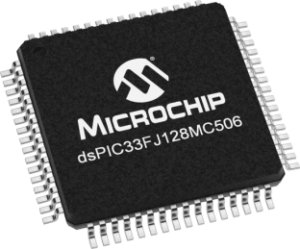
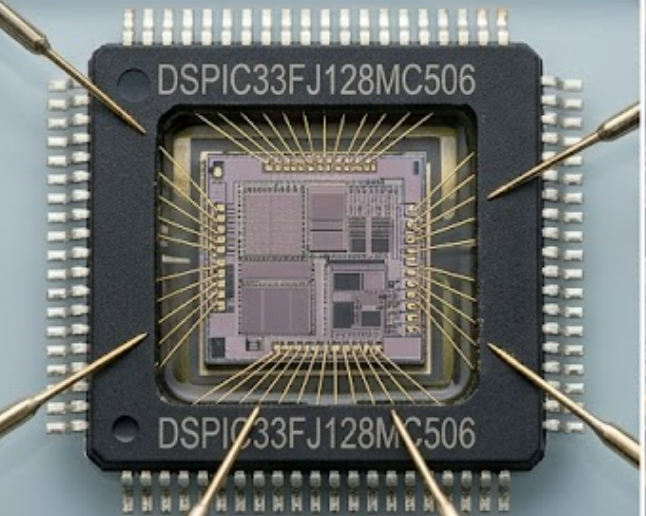
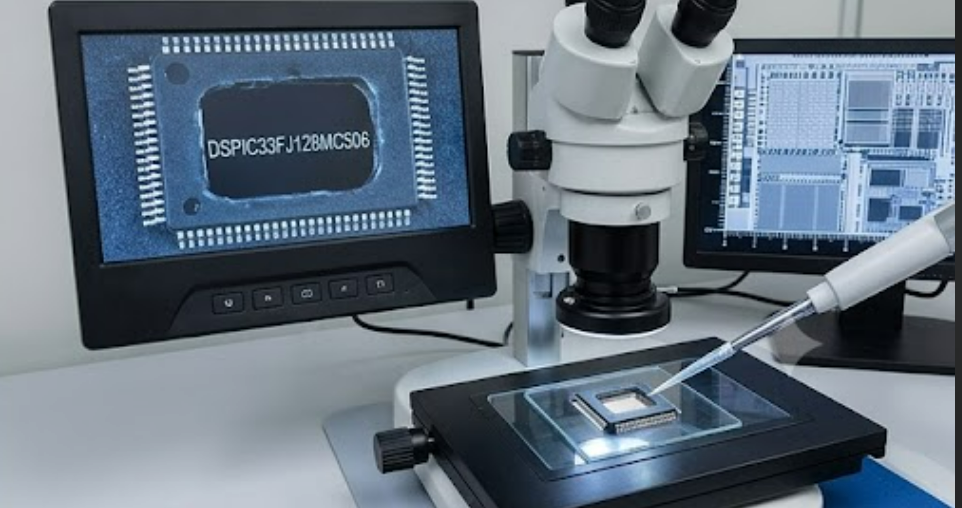
Decode Microcomputer IC Microchip DSPIC33FJ128MC506
12-bit Analog-to-Digital Converter (ADC) Module
For this revision of silicon, the 12-bit ADC module
INL, DNL and signal acquisition time parameters are not within the published data sheet specifications. 10-bit ADC Module
For this revision of silicon, the 10-bit ADC module
DNL, conversion speed and signal acquisition time parameters are not within the published data sheet specifications.
DMA Module: Interaction with EXCH Instruction
The EXCH instruction does not execute correctly when one of the operands contains a value equal to the address of the DMAC SFRs.
DISI Instruction
The DISI instruction will not disable interrupts if a DISI instruction is executed in the same instruction cycle that the DISI counter decrements to zero.
Pour déverrouiller un microcontrôleur Microchip dsPIC33FJ128MC506 sécurisé, il faut contourner ses bits de configuration de protection, notamment les fusibles Code Guard et General Segment Security, qui bloquent l’accès externe aux mémoires FLASH et EEPROM. Les outils de programmation standard ne peuvent pas effectuer de lecture sur le microprocesseur Microchip dsPIC33FJ128MC506 lorsque ces fusibles sont activés. Un processus de déverrouillage professionnel implique l’exploitation de vulnérabilités matérielles telles que l’injection de fautes, l’analyse par canaux auxiliaires ou le micro-sondage invasif. Une fois le microcontrôleur Microchip dsPIC33FJ128MC506 déverrouillé, les ingénieurs peuvent extraire l’intégralité du contenu de la mémoire dans un fichier hexadécimal ou binaire. Ce fichier contient le firmware, qui peut ensuite être déchiffré (s’il est chiffré), copié, répliqué ou programmé dans un nouveau microcontrôleur Microchip dsPIC33FJ128MC506. La logique équivalente au code source extraite permet une rétro-ingénierie complète du logiciel du microcontrôleur Microchip dsPIC33FJ128MC506. Contrairement à un simple clonage, notre service de décodage préserve l’intégrité des données et fournit une archive exploitable pour la production.
Das Knacken eines gesicherten Microchip dsPIC33FJ128MC506-Mikrocontrollers bedeutet, dessen Schutzkonfigurationsbits – insbesondere die Code Guard- und General Segment Security-Sicherungen – zu umgehen, die den externen Zugriff auf die Flash- und EEPROM-Arrays blockieren. Standard-Programmierwerkzeuge können keinen Auslesevorgang auf dem Microchip dsPIC33FJ128MC506-Mikrocontroller durchführen, wenn diese Sicherungen gesetzt sind. Ein professionelles Entsperrverfahren nutzt Hardware-Schwachstellen wie Fehlereinspeisung, Seitenkanalanalyse oder invasive Mikro-Probing-Verfahren aus. Sobald der Microchip dsPIC33FJ128MC506-Mikrocontroller entsperrt ist, können Techniker den gesamten Speicherinhalt in eine Hex- oder Binärdatei auslesen. Diese Datei enthält die Firmware, die anschließend entschlüsselt (falls verschlüsselt), kopiert, repliziert oder auf einen neuen Microchip dsPIC33FJ128MC506-Mikrocontroller programmiert werden kann. Die extrahierte Quellcode-äquivalente Logik ermöglicht das vollständige Reverse Engineering der Software des Microchip dsPIC33FJ128MC506 Mikrocontrollers. Im Gegensatz zum einfachen Klonen bewahrt unser Dekodierungsdienst die Datenintegrität und liefert ein produktionstaugliches Archiv.Das Knacken eines gesicherten Microchip dsPIC33FJ128MC506-Mikrocontrollers bedeutet, dessen Schutzkonfigurationsbits – insbesondere die Code Guard- und General Segment Security-Sicherungen – zu umgehen, die den externen Zugriff auf die Flash- und EEPROM-Arrays blockieren. Standard-Programmierwerkzeuge können keinen Auslesevorgang auf dem Microchip dsPIC33FJ128MC506-Mikrocontroller durchführen, wenn diese Sicherungen gesetzt sind. Ein professionelles Entsperrverfahren nutzt Hardware-Schwachstellen wie Fehlereinspeisung, Seitenkanalanalyse oder invasive Mikro-Probing-Verfahren aus. Sobald der Microchip dsPIC33FJ128MC506-Mikrocontroller entsperrt ist, können Techniker den gesamten Speicherinhalt in eine Hex- oder Binärdatei auslesen. Diese Datei enthält die Firmware, die anschließend entschlüsselt (falls verschlüsselt), kopiert, repliziert oder auf einen neuen Microchip dsPIC33FJ128MC506-Mikrocontroller programmiert werden kann. Die extrahierte Quellcode-äquivalente Logik ermöglicht das vollständige Reverse Engineering der Software des Microchip dsPIC33FJ128MC506 Mikrocontrollers. Im Gegensatz zum einfachen Klonen bewahrt unser Dekodierungsdienst die Datenintegrität und liefert ein produktionstaugliches Archiv.
Motor Control PWM
There is a glitch in the PWMxL signal in Single-Shot mode with complementary output. Another glitch occurs when resuming from a Fault condition in Free-Running mode with complementary output.
10. SPI Module in Slave Select Mode
The SPI module Slave Select functionality will not work correctly.
11. SPI Module
The SMP bit does not have any effect when the SPI module is configured for a 1:1 prescale factor in Master mode.
12. ECAN™ Module
ECAN transmissions may be incorrect if multiple transmit buffers are simultaneously queued for transmission.
13. ECAN Module
Under specific conditions, the first five bits of a transmitted identifier may not match the value in the transmit buffer ID register.
14. ECAN Module Loopback Mode
The ECAN module (ECAN1 or ECAN2) does not function correctly in Loopback mode.
15. I2C™ Module
The bus collision status bit does not get set when a bus collision occurs during a Restart or Stop event.
16. INT0, ADC and Sleep/Idle Mode ADC event triggers from the INT0 pin will not wake-up the device from Sleep or Idle mode if the SMPI bits are non-zero.
17. Doze Mode and Traps
The address error trap, stack error trap, math error trap and DMA error trap will not wake-up a device from Doze mode.
18. JTAG Programming
JTAG programming does not work.
The following sections will describe the errata and work around to these errata, where they may apply.
Per sbloccare un microcontrollore Microchip dsPIC33FJ128MC506 protetto, è necessario aggirare i suoi bit di configurazione di protezione, in particolare i fusibili Code Guard e General Segment Security, che bloccano l’accesso esterno alle memorie FLASH ed EEPROM. Gli strumenti di programmazione standard non possono eseguire una lettura sul microprocessore Microchip dsPIC33FJ128MC506 quando questi fusibili sono attivi. Un processo di sblocco professionale prevede lo sfruttamento di vulnerabilità hardware come l’iniezione di errori, l’analisi dei canali laterali o la micro-sondaggio invasivo. Una volta sbloccato il microcontrollore Microchip dsPIC33FJ128MC506, gli ingegneri possono estrarre l’intero contenuto della memoria in un file esadecimale o binario. Questo file contiene il firmware, che può quindi essere decrittografato (se crittografato), copiato, replicato o programmato in un nuovo microcontrollore Microchip dsPIC33FJ128MC506. La logica equivalente al codice sorgente estratta consente il reverse engineering completo del software del microcontrollore Microchip dsPIC33FJ128MC506. A differenza della semplice clonazione, il nostro servizio di decodifica preserva l’integrità dei dati e fornisce un archivio utilizzabile per la produzione.
The need to UNLOCK and DUMPfirmware from OUTDATE or OBSOLETE dsPIC33FJ128MC506 microcontrollers arises from three real‑world scenarios. First, legacy industrial equipment: many servo drives and motor controllers still rely on this chip, but the manufacturer no longer exists or has stopped supporting the PROGRAM. Without a READOUT, a single MCU failure would scrap an entire production line. Second, automotive electronics: electric power steering modules with encryptedMEMORY often fail after years of use, and replacement parts are unavailable. Third, medical device maintenance: diagnostic and imaging systems using this DSP‑enhanced microprocessor require FIRMWARE recovery to extend their service life. By offering a reliable CRACK and COPY service, we prevent costly system redesigns, reduce electronic waste, and restore functionality to outdated equipment. The importance of this service cannot be overstated – it preserves intellectual property and enables sustainable repair.
Descifrar un microcontrolador Microchip dsPIC33FJ128MC506 protegido implica eludir sus bits de configuración de protección, específicamente los fusibles Code Guard y General Segment Security, que bloquean el acceso externo a las matrices FLASH y EEPROM. Las herramientas de programación estándar no pueden realizar una lectura en el microprocesador Microchip dsPIC33FJ128MC506 cuando estos fusibles están activados. Un proceso de desbloqueo profesional implica explotar vulnerabilidades de hardware como la inyección de fallos, el análisis de canales laterales o el microsondaje invasivo. Una vez desbloqueado el microcontrolador Microchip dsPIC33FJ128MC506, los ingenieros pueden volcar el contenido completo de la memoria en un archivo hexadecimal o binario. Este archivo contiene el firmware, que luego se puede descifrar (si está cifrado), copiar, replicar o programar en un nuevo microcontrolador Microchip dsPIC33FJ128MC506. La lógica equivalente al CÓDIGO FUENTE extraído permite la ingeniería inversa completa del SOFTWARE del microcontrolador Microchip dsPIC33FJ128MC506. A diferencia de la clonación simple, nuestro servicio DECODIFICACIÓN preserva la integridad de los DATOS y proporciona un archivo utilizable para la producción.
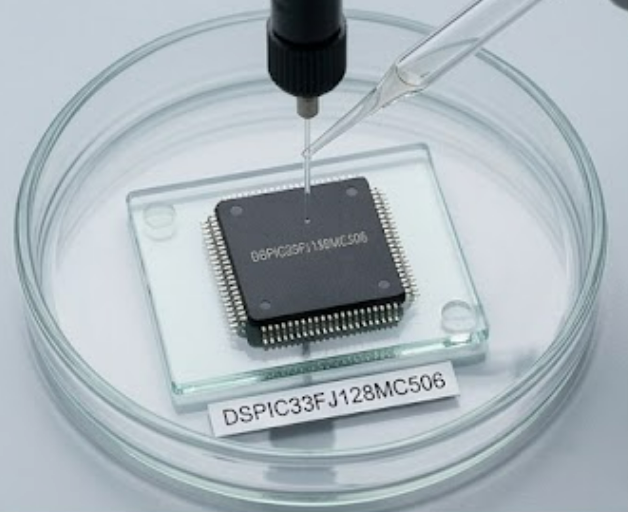
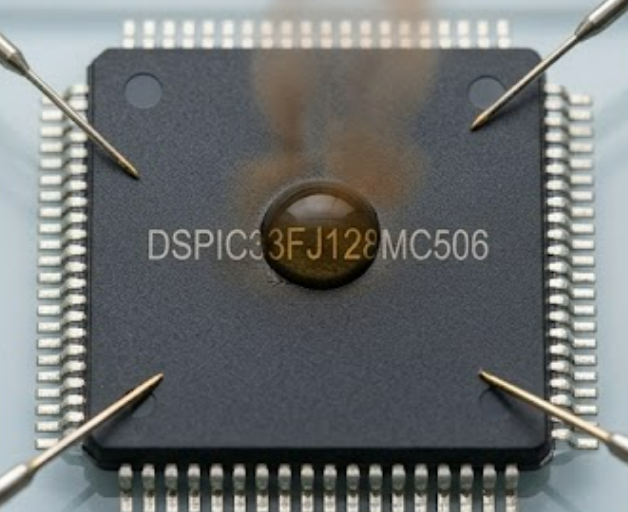
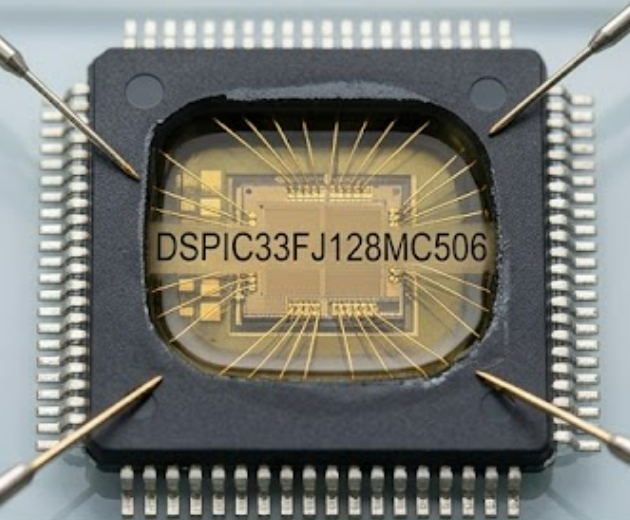
We specialise in providing confidential, fast, and accurate DECODE services for the dsPIC33FJ128MC506 and hundreds of other microcontrollers, ARM, CPLD, and DSP devices. Our laboratory is equipped with advanced decapsulation stations, laser fault injectors, and high‑precision glitching hardware. For this IC, we can CRACK the LOCKED security fuses using non‑destructive or semi‑invasive methods, then DUMP the complete FLASH and EEPROMMEMORY into a HEXIMAL or BINARYFILE. If the FIRMWARE is encrypted, we perform DECRYPT to obtain the raw DATA. The final output is a clean archive ready for REPLICATE, COPY, or reprogramming into new chips. Whether you need to readout a single obsoletemicrochip or clone hundreds of units, our team delivers results. Contact us with your lockedmicrocontroller, and we will return a fully functional PROGRAMFILE – turning a protectiveblack box into a usable SOURCE CODEarchive.
Quebrar a segurança de um microcontrolador Microchip dsPIC33FJ128MC506 significa contornar seus bits de configuração PROTETORES – especificamente os fusíveis Code Guard e General Segment Security – que bloqueiam o acesso externo aos arrays FLASH e EEPROM. Ferramentas de programação padrão não conseguem realizar uma LEITURA no microprocessador Microchip dsPIC33FJ128MC506 quando esses fusíveis estão ativados. Um processo de DESBLOQUEIO profissional envolve a exploração de vulnerabilidades de hardware, como injeção de falhas, análise de canal lateral ou micro-sondagem invasiva. Uma vez que o microcontrolador Microchip dsPIC33FJ128MC506 é desbloqueado, os engenheiros podem DESPEJAR todo o conteúdo da MEMÓRIA em um ARQUIVO HEXIMAL ou BINÁRIO. Este ARQUIVO contém o FIRMWARE, que pode então ser DESCRIPTOGRAFADO (se criptografado), COPIADO, REPLICADO ou programado em um novo microcontrolador Microchip dsPIC33FJ128MC506. A lógica equivalente ao CÓDIGO-FONTE extraído permite a engenharia reversa completa do SOFTWARE do microcontrolador dsPIC33FJ128MC506 da Microchip. Ao contrário da simples clonagem, nosso serviço de DECODIFICAÇÃO preserva a integridade dos DADOS e entrega um arquivo utilizável para produção.
Send us the part number, package type and quantity and we will confirm the feasible method, the deliverable and the turnaround before any sample is touched.