-
Product Categories
-
Live Support Chat


Unlock MCU Chip Microchip PIC16F946
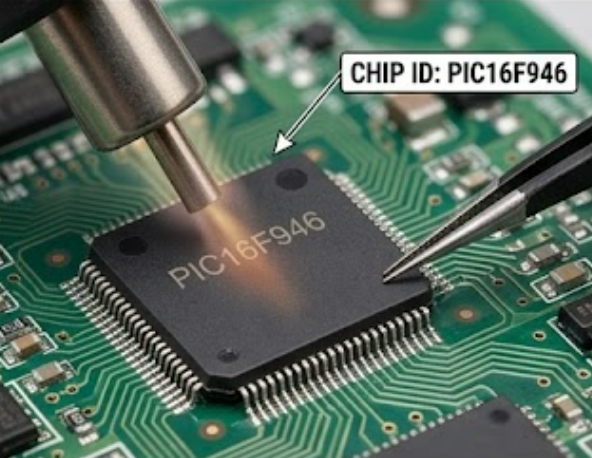
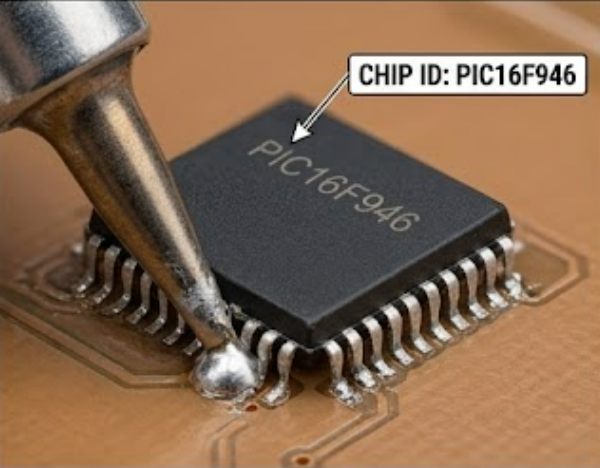
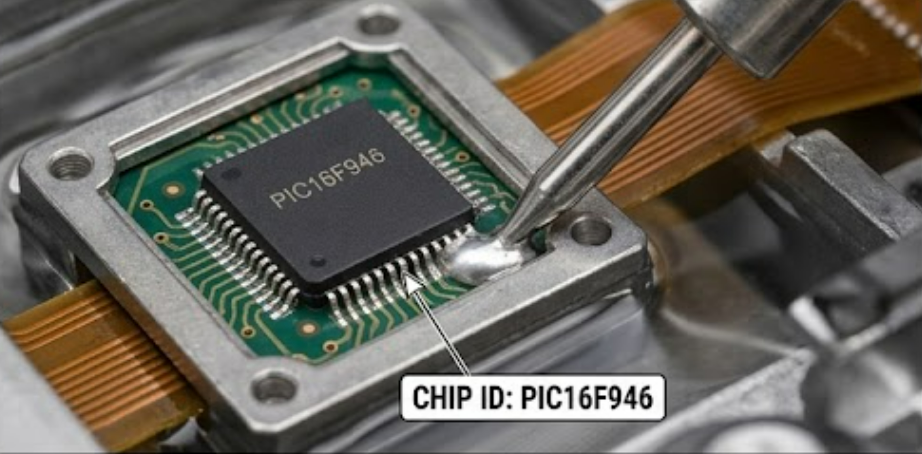
The Microchip PIC16F946 is an established, highly integrated 8-bit Microcontroller featuring an onboard Liquid Crystal Display (LCD) driver block, making it a cornerstone component in precision utility meters, medical monitoring equipment, industrial environmental regulators, and automotive dashboard instrumentation. This specific MCU balances efficiency and functionality, housing dedicated FLASH engine space, an independent EEPROM data MEMORY bank, and highly stable internal oscillators within its physical IC packaging. To safeguard proprietary control algorithms and critical operational profiles, manufacturers intentionally activate the hardware’s native security fuses. This creates a highly PROTECTIVE digital barrier that converts the system into a LOCKED environment, preventing external debugging instruments from initiating unauthorized reading or scanning of internal registers to protect the integrated intellectual property.
High-Performance RISC CPU:
· Only 35 instructions to learn:
– All single-cycle instructions except branches
· Operating speed:
– DC – 20 MHz oscillator/clock input
– DC – 200 ns instruction cycle
· Program Memory Read (PMR) capability
· Interrupt capability
· 8-level deep hardware stack
· Direct, Indirect and Relative Addressing modes
Special Microcontroller Features:
· Precision Internal Oscillator:
– Factory calibrated to ±1%
– Software selectable frequency range of 8 MHz to 32 kHz
– Software tunable
– Two-Speed Start-up mode
– Crystal fail detect for critical applications
– Clock mode switching during operation for power savings
· Power-saving Sleep mode
· Wide operating voltage range (2.0V-5.5V)
· Industrial and Extended temperature range
· Power-on Reset (POR)
· Power-up Timer (PWRT) and Oscillator Start-up Timer (OST)
· Brown-out Reset (BOR) with software control option
· Enhanced Low-Current Watchdog Timer (WDT) with on-chip oscillator (software selectable nominal 268 seconds with full prescaler) with software enable
· Multiplexed Master Clear with pull-up/input pin
· Programmable code protection
· High-Endurance Flash/EEPROM cell:
– 100,000 write Flash endurance
– 1,000,000 write EEPROM endurance
– Flash/Data EEPROM retention: > 40 years
The Technical Reality Behind Microcontroller Decryption and Extraction
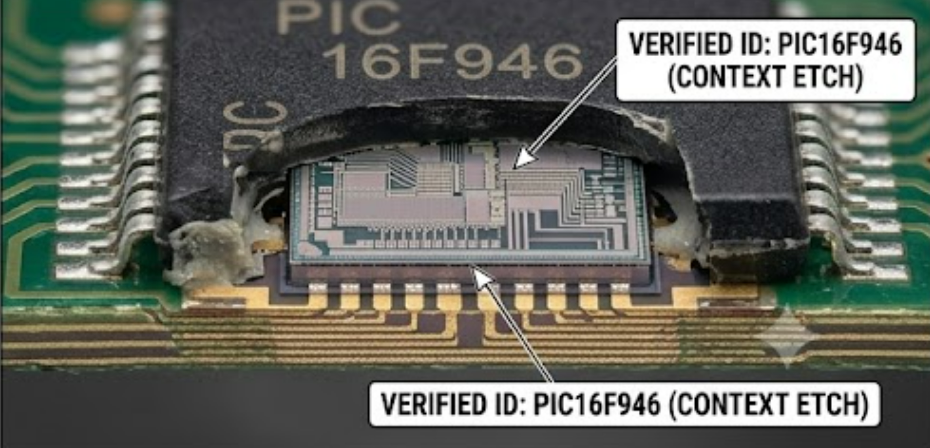
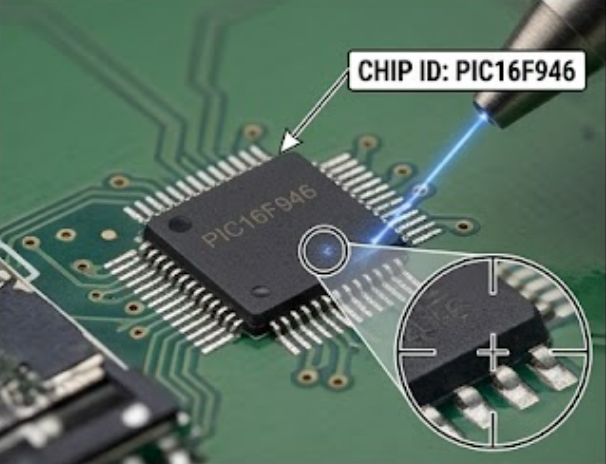
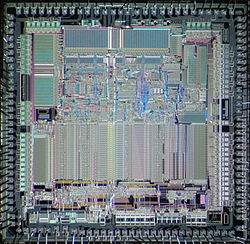
When a system architecture requires engineers to UNLOCK, DECRYPT, or safely CRACK an ENCRYPTED security matrix, it involves complex, localized semiconductor analysis. To successfully execute a clean READOUT or data DUMP from a secured Microprocessor, recovery professionals do not rely on standard programming scripts. Instead, they use specialized hardware tools to temporarily modify the chip’s internal protection logic. By utilizing controlled micro-probing techniques or precise electrical fault-injection profiles on the silicon substrate, engineers can clear the security flags without damaging the core configuration registers. This delicate process safely opens access to the internal storage arrays, allowing technicians to reconstruct the complete system DATA into pristine, intact BINARY or HEXIMAL code blocks for validation.
Low-Power Features:
· Standby Current:
– <100 nA @ 2.0V, typical
· Operating Current:
– 8.5 ìA @ 32 kHz, 2.0V, typical
– 100 ìA @ 1 MHz, 2.0V, typical
· Watchdog Timer Current:
– 1 ìA @ 2.0V, typical
Peripheral Features:
· Liquid Crystal Display module:
– Up to 168 pixel drive capability
– Selectable clock source
– Four commons
· Up to 53 I/O pins and 1 input-only pin:
– High-current source/sink for direct LED drive
– Interrupt-on-pin change
– Individually programmable weak pull-ups
· In-Circuit Serial Programming™ (ICSP™) via two pins
· Analog comparator module with:
– Two analog comparators
– Programmable on-chip voltage reference (CVREF) module (% of VDD)
– Comparator inputs and outputs externally accessible
· A/D Converter:
– 10-bit resolution and 8 channels
· Timer0: 8-bit timer/counter with 8-bit programmable prescaler
· Enhanced Timer1:
– 16-bit timer/counter with prescaler
– External Gate Input mode
– Option to use OSC1 and OSC2 as Timer1 oscillator if INTOSCIO or LP mode is selected
· Timer2: 8-bit timer/counter with 8-bit period register, prescaler and postscaler
· Addressable Universal Synchronous Asynchronous Receiver Transmitter (AUSART)
· 2 Capture, Compare, PWM modules:
– 16-bit Capture, max. resolution 12.5 ns
– 16-bit Compare, max. resolution 200 ns
Market Realities: Why Legacy Code Duplication is Crucial for Modern Enterprise
In today’s fast-moving industrial landscape, the commercial imperative to REPLICATE, COPY, or restore embedded control logic is driven by supply chain constraints and the reality of aging infrastructure. Many manufacturing plants run on systems powered by an OBSOLETE or completely OUTDATE Microchip that is no longer supported by its original manufacturer. If the original development agency goes out of business, or the foundational SOURCE CODE repository is lost or corrupted over time, operations face significant financial risks. Reclaiming the compiled executable PROGRAM from an operational backup unit is often the only way to avoid complete system downtime. Extracting this vital execution SOFTWARE into a stable, archival FILE format allows engineering teams to keep critical systems running, verify structural behavior, and clone older control elements onto fresh replacement components.
Advanced Silicon Engineering and Comprehensive IC Architecture Capabilities
Our laboratory specializes in advanced semiconductor analysis, reverse engineering, and high-fidelity code extraction from complex embedded platforms. Beyond standard 8-bit controllers, our engineering team regularly works with high-density ARM devices, dedicated DSP architectures, complex programmable logic devices (CPLD), and specialized memory controllers. We utilize advanced cleanroom equipment to safely navigate hardware-level protection mechanisms without damaging the underlying silicon structures.
Our specialized workflows transform hidden, extracted machine data into completely verified, deployable FIRMWARE configurations. This ensures your development teams receive reliable, production-ready code that can be written directly to replacement hardware. By partnering with us, you eliminate the need for costly, multi-year software development cycles and safeguard your critical legacy operations. Contact our engineering team today to evaluate your hardware recovery options and protect your embedded assets.