Decode MCU STMicroelectronics ST10F168SQ6
The STMicroelectronics ST10F168SQ6 is a high-performance 16-bit microcontroller (MCU) built for demanding industrial applications, including automotive control systems, precision instruments, and real-time embedded environments. As part of the ST10 family, it integrates advanced control features with robust security mechanisms, making it a favored choice where protected firmware, encrypted memory, and reliable program execution are required. However, situations may arise where engineers or system integrators need to decode MCU STMicroelectronics ST10F168SQ6 to access or recover the embedded program, especially in legacy systems or when critical source code is no longer available.
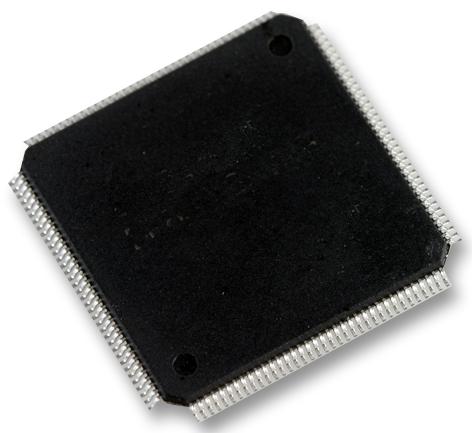
This MCU combines powerful real-time performance with enhanced flash and EEPROM memory protection. Once the readout protection fuse bit is activated, access to internal memory, including binary files, configuration data, and user firmware, becomes locked. This prevents unauthorized copying, replication, or reverse engineering, but also complicates legitimate recovery scenarios.
STMicroelectronics implemented multiple layers of security into the ST10F168SQ6 to safeguard sensitive program information. This includes fuse-based locking, encrypted storage blocks, and restricted debug interfaces, all designed to block any standard method to extract, readout, or dump the MCU’s archive content. This makes bypassing the protection—while technically feasible—a highly specialized process.
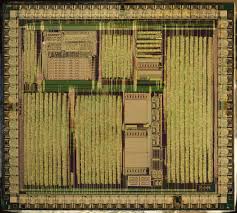
Decode MCU STMicroelectronics ST10F168SQ6, please view below the MCU feature for your reference:
HIGH PERFORMANCE CPU
– 16-BIT CPU WITH 4-STAGE PIPELINE
– 80ns INSTRUCTION CYCLE TIME AT 25MHz
CPU CLOCK
– 400ns 16 X 16-BIT MULTIPLICATION
– 800ns 32 / 16-BIT DIVISION
– ENHANCED BOOLEAN BIT MANIPULATION
MEMORY ORGANIZATION
– 256K BYTE ON-CHIP FLASH MEMORY
– 10K ERASING / PROGRAMMING CYCLES
– UP TO 16M BYTE LINEAR ADDRESS SPACE
FOR CODE AND DATA (5M BYTE WITH CAN)
– 2K BYTE ON-CHIP INTERNAL RAM (IRAM)
– 6K BYTE ON-CHIP EXTENSION RAM (XRAM)
– 20 YEAR DATA RETENTIO N TIME FAST AND FLEXIBLE BUS
– PROGRAMMABLE EXTERNAL BUS CHARACTERISTICS FOR DIFFERENT ADDRESS RANGES
– 8-BIT OR 16-BIT EXTERNAL DATA BUS
– MULTIPLEXED OR DEMULTIPLEXED EXTERNAL ADDRESS / DATA BUSES
– FIVE PROGRAMMABLE CHIP-SELECT SIGNALS
– HOLD-ACKNOWLEDGE BUS ARBITRATION
SUPPORT
INTERRUPT
– 16-CHANNEL 10-BIT
– 7.76µS CONVERSION TIME
FAIL-SAFE PROTECTIO N
– PROGRAMMABLE WATCHDOG TIMER
– OSCILLATOR WATCHDOG
ON-CHIP CAN 2.0B INTERFACE
ON-CHIP BOOTSTR AP LOADER
CLOCK GENERATION
– ON-CHIP PLL
– DIRECT OR PRESCALED CLOCK INPUT.
UP TO 111 GENERAL PURPOSE I/O LINES
– INDIVIDUALLY PROGRAMMABLE AS INPUT,
OUTPUT OR SPECIAL FUNCTION.
– PROGRAMMABLE THRESHOLD (HYSTERESIS)
IDLE AND POWER DOWN MODES
SINGLE VOLTAGE SUPPLY: 5V ±10%
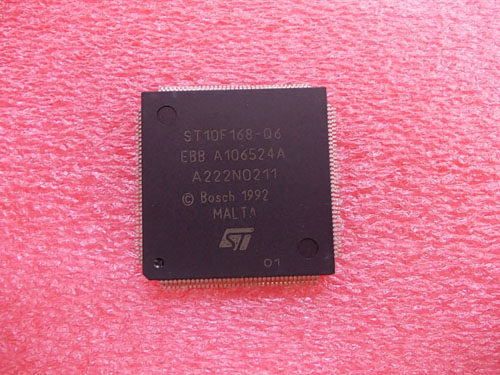
144-PIN PQFP PACKAGE
To break or unlock a secured ST10F168SQ6, one must bypass its fuse bit security and gain controlled access to the internal firmware. The fuse bit, once set, disables memory access even via standard debugging or programming tools. This adds an extra layer of difficulty for any effort to recover or restore the firmware. In many cases, efforts may involve hardware-level analysis, understanding the microprocessor internals, and controlled decapsulation or chip-level analysis.
Despite these challenges, professional recovery is possible without revealing or depending on high-risk invasive methods. The key is experience, precision, and access to the right tools and technology.
We provide a highly reliable and professional solution to decode MCU STMicroelectronics ST10F168SQ6. Our team is skilled in securely retrieving embedded firmware and binary files from protected or encrypted microcontrollers without damaging the chip or compromising the data. Whether your objective is to clone, duplicate, or simply restore the original program, we are equipped to handle even the most complex MCU recovery cases.
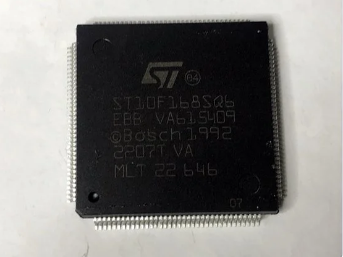
We can successfully bypass readout protection, safely remove or neutralize fuse bit locks, and access critical memory files from the ST10F168SQ6. Once unlocked, we extract and deliver the heximal, EEPROM, and flash data, enabling you to replicate the functionality or continue your development process.
Tags: rotura mcu entsrapted hex,rotura mcu entsrapted memory,rotura mcu entsrapted program